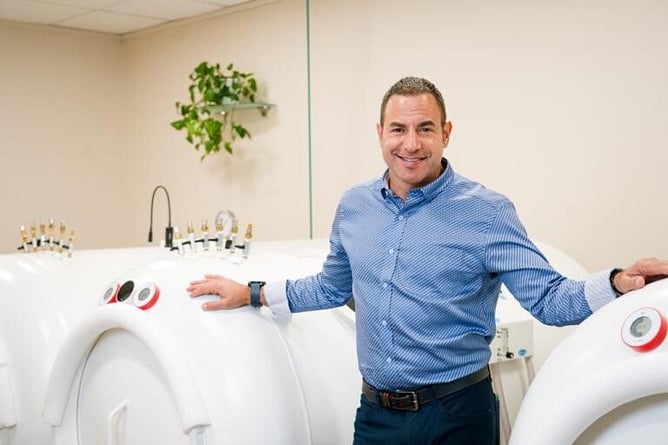
By Lisa Tamati | Long Life Hyperbarics, New Plymouth
If you've ever wondered why hyperbaric oxygen therapy keeps showing up in conversations about healing, longevity, and performance — this one's for you.
I recently sat down with Dr Jason Sonners on my Pushing The Limits podcast for a deep dive into the science of how hyperbaric oxygen therapy (HBOT) actually works, why it helps with so many different conditions, and what the latest research is telling us about its potential for everything from brain injuries to immune function to anti-ageing.
Dr Jason is one of the world's leading hyperbaric practitioners. He's a certified hyperbaric practitioner, Clinic Director of NJ HBOT and HBOT USA, and author of the book Oxygen Under Pressure. He combines HBOT with exercise, nutrition, and detoxification to support patients through conditions including autoimmune and neurological issues, autism, allergies, cancer, and more. He's also completing his PhD research comparing the effects of different pressures on inflammation, epigenetics, telomere length, and cognitive function.
And like so many of us in this space — his journey into hyperbaric started with his own health crisis.
A Herniated Disc That Changed Everything
Dr Jason's background is in exercise physiology, chiropractic, and nutrition. He and his wife were practising in New Jersey when he herniated a disc carrying roofing shingles up a ladder. Despite 18 months of chiropractic treatment, proper nutrition, and rehab, he still had full drop foot — complete nerve damage to his right leg.
Then he stumbled across a hyperbaric chamber at a chiropractic conference. He did a 30-minute session and didn't think much of it. Twenty minutes later, he started getting pins and needles in his foot for the first time in 18 months.
He ended up doing about eight hours over four days and saw roughly 20% improvement. He purchased a chamber, treated himself at home, and achieved full resolution of his neuropathy.
The kicker? No one in his entire professional network had ever mentioned hyperbaric to him. It was a complete accident — and the only thing that actually worked.
That experience lit a fire. Dr Jason has since helped set up almost 30 hyperbaric clinics and trained over 175 practitioners through the International Board of Undersea Medicine.
Why Hyperbaric Isn't a Cure — But Helps With Almost Everything
One of the things I appreciate most about Dr Jason is his honesty. As he puts it: HBOT doesn't cure anything — it just helps with so many things.
Here's the core mechanism: virtually every cell in your body (except red blood cells) uses oxygen to make energy. Your mitochondria — the powerhouses inside each cell — need oxygen to produce ATP, the energy currency that drives all cellular function.
Even when you're at 100% oxygen saturation (which most of us are at sea level), that doesn't mean you have surplus oxygen available for healing. Your body is constantly redirecting oxygen based on what tissues are working hardest — brain, gut, muscles. There's never really a reservoir.
This is where hyperbaric changes the game.
How Pressure Changes Everything
When you enter a hyperbaric chamber, you breathe oxygen under increased atmospheric pressure. This does something remarkable: it compresses oxygen molecules so they dissolve directly into your blood plasma — not just attaching to red blood cells, but saturating the liquid portion of your blood.
At normal sea level, your blood plasma contains about 0.3 millilitres of oxygen per 100ml of blood. In hyperbaric conditions, that jumps to roughly 20 times more.
Why does this matter? Red blood cells are large. They can't squeeze through damaged capillaries, past inflammation, or across the blood-brain barrier easily. But plasma goes everywhere. So now you've got oxygen-rich liquid reaching tissues that have been starving — old injuries, crush injuries, stroke-affected brain tissue, damaged nerves.
This is why hyperbaric oxygen therapy in New Plymouth at Long Life Hyperbarics can support recovery from such a wide range of conditions. It's not targeting one specific thing — it's giving your body the fundamental resource it needs to repair itself.
Short-Term and Long-Term Benefits
Dr Jason breaks the benefits into two categories:
Immediate (mechanical) benefits: More oxygen means more efficient mitochondrial function and more ATP production. This happens every single session. It's why athletes use short 20–30 minute sessions for a performance boost, and why many people feel deeply relaxed during longer sessions — HBOT drives your nervous system into parasympathetic (rest and repair) mode.
Long-term (signalling) benefits: This is where things get really interesting. The cycle of hyperoxygenation inside the chamber followed by a return to normal oxygen levels when you get out creates a relative hypoxic signal. Your body interprets this shift as a stimulus to upregulate stem cell production, trigger angiogenesis (the building of new blood vessels), and strengthen your immune system.
Research has shown significant decreases in immune system senescent cells (zombie cells that cause chaos in your body) and approximately a 20% increase in telomere length — the protective caps on your DNA associated with biological ageing.
What Conditions Can HBOT Help With?
The medically approved indications include wound healing, gangrene, carbon monoxide poisoning, and decompression sickness. But the mechanisms that make HBOT work for those conditions apply far more broadly:
Infections and immune support: High-pressure oxygen reduces the activity of anaerobic organisms, helps break down biofilms, and energises white blood cells to fight both bacterial and viral infections more effectively. There's also a well-documented synergy between hyperbaric and antibiotics.
Neurological conditions: Diabetic neuropathy, post-stroke recovery, traumatic brain injury, and concussion are areas where HBOT shows strong clinical results. By flooding oxygen into damaged neural tissue through the plasma, nerves that have been starving can begin to heal.
Inflammation and recovery: Whether from old sports injuries, surgery, or chronic inflammatory conditions, HBOT helps modulate the inflammatory response while delivering the oxygen tissues need to regenerate.
Longevity and anti-ageing: The combination of stem cell stimulation, senescent cell clearance, telomere lengthening, and improved mitochondrial function makes HBOT one of the most compelling longevity tools available. When combined with other strategies like fasting, ketogenic nutrition, or red light therapy, the synergistic effects multiply.
This is exactly why I run both hyperbaric oxygen therapy and red light therapy at our clinic here in New Plymouth — these therapies complement each other beautifully.
Oxidative Stress: When It's Your Friend
One of the most common questions people ask is: doesn't extra oxygen cause oxidative stress? Isn't that bad?
Dr Jason explains the nuance beautifully. Environmental oxidative stress — from pollution, poor diet, or toxins — strips your antioxidant defences and damages cell membranes, mitochondria, and DNA. That's destructive.
But the mild oxidative stress generated internally by your mitochondria during HBOT is a different story. It acts as a hormetic stimulus — similar to exercise. It triggers your body to upregulate its own antioxidant systems, particularly superoxide dismutase (SOD) and glutathione.
The key is starting with appropriate exposure and building up gradually, just as you wouldn't run a marathon without training. For fragile or chronically ill individuals, protocols start gently and increase over time as tolerance builds.
The Importance of Protocols
This is something I'm passionate about. Hyperbaric is a powerful tool, but the application matters enormously. For generally healthy people using HBOT for wellness and longevity, periodic sessions are relatively straightforward and safe. But for people dealing with serious health challenges — cancer, autoimmune conditions, neurodegenerative disease — combining HBOT with other therapies requires careful protocol design.
At Long Life Hyperbarics in New Plymouth, we understand that one size doesn't fit all. Whether you're recovering from an injury, managing a chronic condition, or investing in your long-term health, proper protocol matters.
What's Next for HBOT Research?
Dr Jason shared some exciting developments. Most hyperbaric research has focused on higher pressures (hospital-grade hard chambers), but his PhD research is now comparing lower-pressure mild hyperbaric chambers with higher-pressure setups — looking at cytokines, inflammation markers, methylation, epigenetics, telomere length, and cognitive function.
Clinically, practitioners see benefits across all pressure levels for different conditions. Having rigorous research to back this up will be a game-changer for accessibility, because mild hyperbaric chambers are what most people will realistically have access to — including what we use here at Long Life Hyperbarics.
Experience Hyperbaric Oxygen Therapy in New Plymouth
If you're in Taranaki and curious about what HBOT could do for you, we'd love to chat. At Long Life Hyperbarics, we offer hyperbaric oxygen therapy sessions at $95, or combined HBOT and red light therapy sessions at $130. We're located at 3A Rahui View, Ōakura, and appointments can be booked by calling 021 844 743.
Whether you're an athlete looking for faster recovery, dealing with a chronic health challenge, or simply investing in your longevity — hyperbaric oxygen therapy could be the missing piece in your health puzzle.
Listen to the full episode: How Hyperbaric Oxygen Therapy Works as a Panacea — Dr Jason Sonners on Pushing The Limits
Learn more about Dr Jason: Visit hbotusa.com or check out the HBOT USA YouTube channel.
Explore our longevity supplements: shop.lisatamati.com
Discover your immune age: myimmuneage.life
Lisa Tamati is a functional health practitioner, longevity specialist, and host of the Pushing The Limits podcast. She runs Long Life Hyperbarics in New Plymouth and has over 15 years of experience in functional medicine, hyperbaric oxygen therapy, and health optimisation.